By Aanant Bisht · 25 November 2026
Every CEO I have worked with feels fear, anger, envy and doubt. That is not the problem. The problem starts when one of those feelings quietly takes the chair at the head of the table and starts running the company while the CEO is still telling everyone, including themselves, that they are calm.
CEO emotional mastery, as I use the term, is not about feeling less. It is about feeling the full weight of a situation and still choosing what to do with a clear head. You let the emotion speak. You do not let it sign the cheque.
Why I stopped trying to feel nothing
When I started in Dubai real estate, I had no network and not much experience. Rejection was a daily event. For a while I tried to treat it the way a lot of driven people do: push the feeling down, act unbothered, keep moving. It worked for a few hours at a time and then leaked out somewhere else, usually in the next conversation with a client who had done nothing wrong.
What changed things was not toughness. It was learning to listen to the feeling for a moment and then decide whether it had anything useful to tell me. Some days the disappointment was pointing at something real: a weak pitch, a wrong market, a client I should never have chased. Other days it was just noise. Over fourteen months that difference added up to more than AED 96 million in sales, a story I tell in my book Zero to 96 Million in 14 Months.
Since then I have coached more than 5,000 Dubai realtors through Realtor One, and I now advise founders and CEOs privately. The stakes in a boardroom are larger than on a property viewing, but the move is the same.
What emotional mastery is not
Before the method, it helps to clear away three things people often mistake for emotional mastery.
- Suppression. Pushing a feeling out of sight does not remove its influence. It only removes your ability to see that influence. A suppressed fear still votes; it just votes anonymously.
- Performed calm. Some leaders learn to look composed while making panicked decisions. The team reads the decisions, not the face. Calm that lives only in your tone of voice protects nobody.
- Endless processing. The opposite error is talking about a feeling so long that the decision window closes. Understanding an emotion is useful. Waiting until it disappears before you act is not.
Mastery sits between these. You feel it fully, you understand what it is asking for, and then you decide as the person responsible for the whole company, not as the person who happens to be upset this afternoon.
Your emotions are advisers, not executives
The picture I give leaders is a simple one. Imagine every strong emotion as a member of your board. Fear is the director who has seen companies die. Anger is the one who notices when a line has been crossed. Excitement is the one who spots opportunity first. Doubt is the auditor.
Every one of them is useful. None of them should be running the company alone. A good chair lets each director speak, asks sharp questions, weighs the advice against the director’s track record, and then makes the call. That is the whole idea behind the framework below.
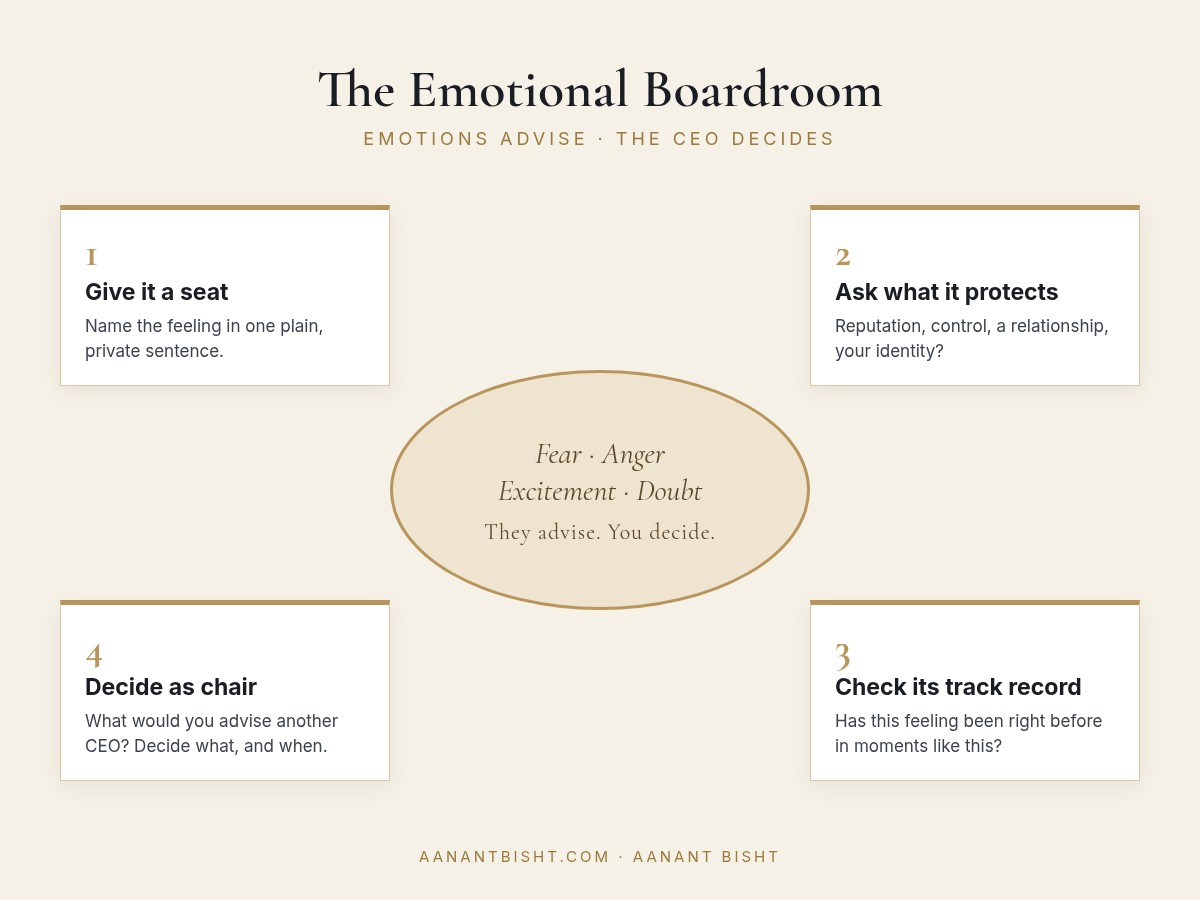
The Emotional Boardroom: a four-step framework
Use this when a feeling is strong enough that you notice it shaping what you want to do next: after a hard investor call, a resignation you did not see coming, a public criticism, or a win that makes you want to say yes to everything.
- Give it a seat. Name the emotion in plain words, privately, in one sentence. “I am angry that the co-founder went around me.” “I am afraid this quarter makes me look like I have lost the plot.” Naming it puts the feeling at the table instead of under it.
- Ask what it is protecting. Every strong emotion is guarding something: your reputation, a relationship, your sense of control, your idea of who you are. Write down what this one is guarding. Often the real issue becomes obvious here.
- Check its track record. Has this feeling been right before in situations like this one? Some leaders have a fear of conflict that has been wrong for twenty years. Others have an instinct about people that has rarely failed them. Give the advice the weight its history has earned, no more and no less.
- Decide as chair. Now ask: if I were advising another CEO in exactly this position, what would I tell them to do, and when? Then decide what you will do, what you will not do, and when you will revisit it. Sometimes the right decision is simply “not today”.
The whole exercise takes a few minutes on paper. It does not replace analysis. My field guide to decision-making under pressure covers how to separate the decision from the feeling for a specific high-stakes call. The Emotional Boardroom is the habit underneath it: how you relate to your own emotions on an ordinary Tuesday, so they are already in order when the big call arrives.
Good feelings need managing too
Most writing on emotional control focuses on fear and anger. In my experience, some of the most expensive CEO decisions are made in a good mood.
A big funding round closes, a major client signs, a quarter beats the plan, and the leader feels unstoppable. That is exactly when people hire too fast, sign leases that are too large, promise the board a growth number nobody has tested, or launch the side project that quietly eats the next year. Excitement is a board member with a strong voice and a short memory.
So run the same four steps after a win. Name it (“I feel invincible right now”). Ask what it protects (“my need to prove the doubters wrong”). Check its record (“the last time I felt this, I overcommitted”). Decide as chair (“no new commitments for seventy-two hours”). Celebrate the win. Just do not let it make the next five decisions for you.
Your team feels what you feel
A CEO’s emotional state does not stay private. People watch the leader closely, especially when things are uncertain, and they adjust their own behaviour to what they see. If you are anxious, your leadership team becomes cautious. If you are irritable, bad news starts to arrive late or not at all. If you are calm and honest, people bring problems to you while they are still small.
This is why emotional mastery is not a private wellness project. It is part of the job. Two practical habits help:
- Say the feeling, then the plan. “I am frustrated by this result. Here is what we are going to do.” Naming it out loud, briefly, stops people guessing, and moving straight to the plan stops the feeling from becoming the meeting.
- Protect the messenger. Notice how you react the first moment you hear bad news. If people get punished for bringing it, they will stop. Thank the person first, react second.
Where this connects to belief
Underneath recurring emotional patterns there is usually a belief: “if I am not in control, things fall apart”, “if I slow down, I will be left behind”, “if they see me struggle, they will stop following me”. These beliefs were often useful once. Many of them helped build the company. Past a certain size, they start to cost more than they give, which is the theme of my essay on why strategy stops scaling past $10 million.
Belief work is not a replacement for therapy, medical care or good advisers. It is the practice of making these hidden rules visible so a leader can decide whether they still fit the company and the life they are building now. The same principle runs through our work with athletes at The Orbits: skill gets you into the arena, and the state you carry into it shapes what you do there.
A weekly checklist for CEO emotional mastery
- Which emotion made the most decisions for me this week, and did I notice it at the time?
- Did I make any commitment within a few hours of a big high or a big low? Does it still look right?
- Which of my emotional “board members” has the worst track record, and am I still giving it a vote?
- Did anyone bring me bad news this week? If not, is that because there was none, or because of how I react?
- What did my team see in me this week, and is that the signal I want them to take into next week?
Frequently asked questions
Is CEO emotional mastery the same as emotional intelligence?
They overlap. Emotional intelligence is usually discussed as a broad set of skills for reading yourself and others. What I mean by emotional mastery is narrower and more practical: the habit of letting a strong feeling inform a decision without letting it make the decision.
Does emotional mastery mean a CEO should never show emotion?
No. Teams generally trust leaders who are honest about how a situation feels and clear about what happens next. Hiding every emotion tends to make people guess, and guesses are usually worse than the truth.
How long does it take to build this skill?
It varies by person and I would be wary of anyone who promises a timeline. Most leaders notice something useful the first time they write the four steps down. Making it automatic under real pressure takes steady practice.
Is this a substitute for therapy?
No. This is advisory work on how a leader thinks, feels and decides at work. If someone is dealing with anxiety, depression or trauma, a qualified clinician is the right person to see, and advisory work can sit alongside that.
Related essay: A Thinking Partner for Founders: Solving the Isolation Problem
If one feeling has been running more of your decisions than you would like, a private conversation is often the quickest way to see it clearly. I offer a free, one-hour, fully confidential strategy conversation for founders and CEOs. Book a private conversation with Aanant.
Pingback: Decision-Making Under Pressure: A Field Guide for Executives
Pingback: Legacy Advisor for CEOs: What a Leader Really Leaves Behind
Pingback: Identity After Selling a Company: Who You Are After the Exit