By Aanant Bisht · 27 November 2026
The deal closes, the money lands, the congratulations arrive. Then, a few weeks later, a quieter question starts to show up on ordinary mornings: what am I actually for now?
Founders rarely talk about this in public, because it sounds ungrateful. You got what you worked for. But the question of identity after selling a company is not a sign that something went wrong. It is what happens when a role you held for years, often a decade or more, stops being the first answer to “who are you?”. This essay is about what that role was quietly doing for you, why the gap can feel so large even after a good exit, and a practical way to rebuild a sense of self that does not depend on any one company.
Why a good exit can still feel like a loss
The useful research here comes from Elizabeth Rouse, an organisational behaviour professor at Boston University. Over two years she conducted 60 interviews with 34 founders of technology companies, most of whom had made voluntary, successful exits. In her summary for LSE Business Review of the study (published in the Academy of Management Journal in 2016), she describes two broad ways founders related to their work.
Some had what she calls a “self-fortifying” orientation. They saw the company mainly as a vehicle for their ideas, were often already involved in the next venture, and experienced leaving as exciting. Their identity as entrepreneurs was reinforced by the exit. Others had a “stewarding” orientation. They saw the company as something worth sustaining in its own right, invested fully in it, and only considered what came next at the point of exit. For many of them the transition was emotionally hard, with sadness, loss and pain, and many needed a break before starting again. Rouse describes their experience as a process of “unbecoming”.
I find that distinction helpful because it removes the shame. If the exit hurts, it is often because you cared about the company as more than an asset. That is not weakness. It is the cost of having been a good steward. It also tells you where to look: not at the money, but at everything the role was providing that you never had to think about.
What the company was quietly doing for you
Most founders can list what they gave the company. Far fewer can list what the company gave them, apart from the financial return. Slow down and look, and five things usually come up.
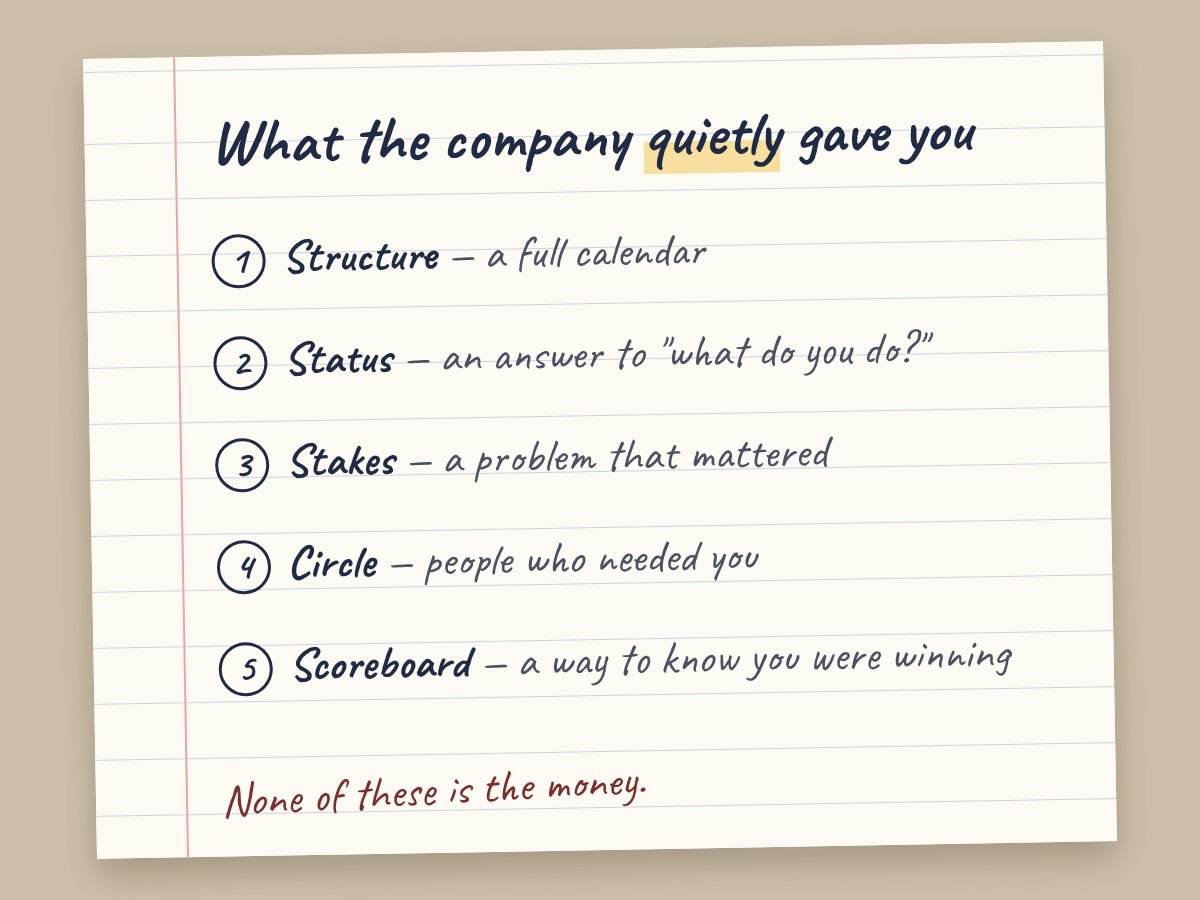
1. Structure
The company decided what your Monday looked like. Board meetings, hiring, customers and crises filled the calendar before you had to choose anything. After the exit the calendar is suddenly empty, and an empty calendar asks a question a full one never did: what do you want to do with a day?
2. Status
“Founder and CEO of X” was a complete answer at any dinner table. It told people what you did, roughly what you were worth to them and how to treat you. Without it, the most common social question becomes awkward. Many people fill the gap with “I’m taking some time”, which is accurate and feels thin.
3. Stakes
Every day the business had a problem that mattered: payroll, a product launch, a competitor, a key hire. Hard problems are tiring, but they also give a day weight. When nothing is at stake, rest can start to feel like drifting.
4. Circle
Your team, your co-founder, your investors and customers needed you. Being needed is one of the strongest sources of meaning most people have. After a sale that circle can disappear almost overnight, and the people who stay in touch may not be the ones you expected.
5. Scoreboard
Revenue, growth, valuation. Whatever you used, you always knew whether you were winning. After the exit the scoreboard is gone, and many founders quietly build a new one around net worth or the next deal, which often brings back the same pressure without the same purpose.
None of these five is the money. That is why a large number in a bank account does not settle the question. It replaces none of them.
A smaller version of the same question in my own work
I have not been through the sale of a large company, and I will not pretend to know that experience from the inside. What I have done is change what I am measured by. In Dubai I closed AED 96 million of property sales in fourteen months; for that period my scoreboard was my own deals. When I wrote that time down in my book, Zero to 96 Million in 14 Months, and later built Realtor One, where I have coached more than 5,000 Dubai realtors, the scoreboard changed. Success stopped meaning “did I close?” and started meaning “did other people get better?”
That is a much smaller shift than an exit, but it taught me the principle this essay rests on. An identity built on a single scoreboard is fragile. An identity built on how you work, what you value and who you help can move from one role to the next without breaking.
The 90-day plan after the exit: land, explore, choose
A common trap after a sale is not grief. It is rushing to end the discomfort with a big commitment: a new company, a large investment, a board seat that looks like the old life. A simple three-phase structure helps you give the question the time it needs.
Days 1 to 30: land
- Make no large, hard-to-reverse decisions. Put a date in the calendar before which you will not start a company, sign a major investment or accept a full-time role.
- Rest on purpose. Sleep, health and family time are not a reward for later; they are the foundation for the next good decision.
- Write down, honestly, which of the five losses above you feel most. Most founders have one that hurts far more than the others.
Days 31 to 60: explore
- Run small, low-cost experiments instead of making plans. Advise one founder. Teach one session. Spend a week on a problem you were curious about but never had time for.
- After each experiment, ask one question: did I feel more like myself, or less?
- Start rebuilding the circle deliberately. Have one honest conversation a week with someone who knew you before the company, not only during it.
Days 61 to 90: choose
- Look at your notes from the experiments. What kind of problem gave you energy? What kind of people?
- Choose a direction for the next year, not for the rest of your life. A year is long enough to matter and short enough to change.
- Design the five functions on purpose: what will give you structure, what you will say when someone asks what you do, what is at stake, who you will serve and how you will know it is working.
Ninety days is a guide, not a rule. Some founders need longer, and that is fine. The point is to separate the urge to stop feeling uncomfortable from the decision about what comes next. Making a big decision while that urge is strong is exactly the kind of pressure I wrote about in my field guide to decision-making under pressure.
Before you sign: six questions to answer while you still own it
The best time to work on identity after selling a company is before the sale. If an exit is on the horizon, these questions are worth answering in writing, ideally months before the paperwork:
- If I could not use my company’s name, how would I introduce myself?
- Which of the five functions (structure, status, stakes, circle, scoreboard) does the company provide that nothing else in my life does?
- Who in my life knows me well apart from the business, and when did I last spend real time with them?
- What did I enjoy doing before I founded this company, and is any of it still alive?
- If the earn-out or transition period keeps me in the building, how will I handle no longer having the final say?
- What would a good first year after the sale look like, apart from the financial outcome?
If several answers are blank, that is useful information, not a reason to delay the deal. It tells you where to start building now, while the company is still giving you the structure to do it.
What this does to the people around you
Identity after an exit is not only a private matter. Partners and children often feel the change before the founder names it. For years the business set the rhythm of the household; now someone who used to be absent is home, restless and unsure what to do. That can be a gift or a strain, depending on whether it is talked about.
Two things help. First, say out loud what is happening, even if it sounds strange: “I’m proud of the sale and I’m also a bit lost.” Second, notice whether the restlessness is turning into irritability or short temper. The same steadiness I described in Emotional Mastery for CEOs applies here: you can feel the discomfort fully without letting it run the house. And the longer view I wrote about in Legacy Beyond the Will becomes very practical after an exit, because for the first time in years you have the hours to work on the ledgers the company crowded out.
When it helps to talk it through
Many founders try to work through this alone, partly because the people closest to them were either part of the company or financially affected by the sale. It can help to talk with someone who has no stake in what you do next and no reason to steer you towards a particular answer. That is the role I described in A Thinking Partner for Founders.
To be clear about limits: if the low mood after an exit is persistent, affects sleep or appetite, or comes with thoughts of hopelessness, please speak to a doctor or a qualified mental health professional. A thinking partner is not a substitute for clinical care.
Frequently asked questions
Is it normal to feel lost after selling a company?
Yes. Research such as Rouse’s study of founder exits shows that founders who saw themselves as stewards of a particular company often experienced sadness and loss after a successful exit and needed a break before starting again. Feeling lost is a common response to losing a role, not a verdict on the deal.
How long does it take to rebuild identity after selling a company?
There is no fixed timeline, and it varies a great deal between people. A useful approach is to avoid big, irreversible commitments for the first few months, run small experiments, and then choose a direction for a year rather than for life.
Should I start a new company straight away?
Some founders do, and do it well, especially if they were already working on the next idea before the exit. If the main reason is to escape the discomfort of not knowing who you are without a company, it is usually worth waiting until you can choose the next thing for its own sake.
Related essay: Belief Work for Executives: What It Is and What It Isn’t
If you have sold a company, or are about to, and the question “who am I now?” keeps coming back, it may help to think it through with someone neutral. I offer a free, one-hour, fully confidential conversation for founders and CEOs. Book a private conversation with Aanant.
Pingback: Mindset After $10 Million: Learning to Enjoy What You Built