By Aanant Bisht · 29 November 2026
There is a moment many founders expect and few describe honestly. The number they spent a decade chasing finally shows up in the bank account, and the feeling they assumed would come with it doesn’t. The calendar is still full. The mind is still scanning for the next threat. The holiday gets interrupted by the same emails. Nothing is wrong, and yet very little feels like enough.
This essay is about the mindset after $10 million: why the inner habits that built the wealth often keep running long after they have done their job, and how to start enjoying what you have actually built. It is written for founders and owners who have crossed a serious financial line, whether through an exit, a dividend, or a business that now runs well, and who suspect the next milestone won’t change how they feel either.
Mindset after $10 million: why the number doesn’t change the feeling
The common assumption is simple: once I have enough, I will relax. It is a reasonable belief. It is also one that very few people test until they get there.
The research on money and happiness is more nuanced than the old “it stops mattering above a certain salary” line. Matthew Killingsworth at the Wharton School analysed more than 1.7 million in-the-moment reports from over 33,000 working adults in the United States. As Penn Today reported, he found well-being kept rising with income, with no clear plateau. But the same work found that income was only a modest factor overall, that people who equated money with success were less happy than those who didn’t, and that higher earners worked longer hours and felt more pressed for time.
His participants were ordinary employed adults, not founders worth eight figures, so I won’t stretch the findings beyond what they show. But two of those points are worth sitting with if you have built significant wealth. If money became your scoreboard for success, more of it may not settle the question you are really asking. And if the way you earned it was by giving it all your time, the habit of being pressed for time doesn’t end when the pressure does.
In other words, the number changed. The person running the number mostly didn’t.
The beliefs that built the money, and keep running after it
Most people who build a company from nothing rely on a small set of working beliefs. They are not mistakes. In the early years they are often exactly what the situation needs. The trouble is that beliefs don’t retire on their own. They keep issuing instructions long after the conditions that made them useful have gone.
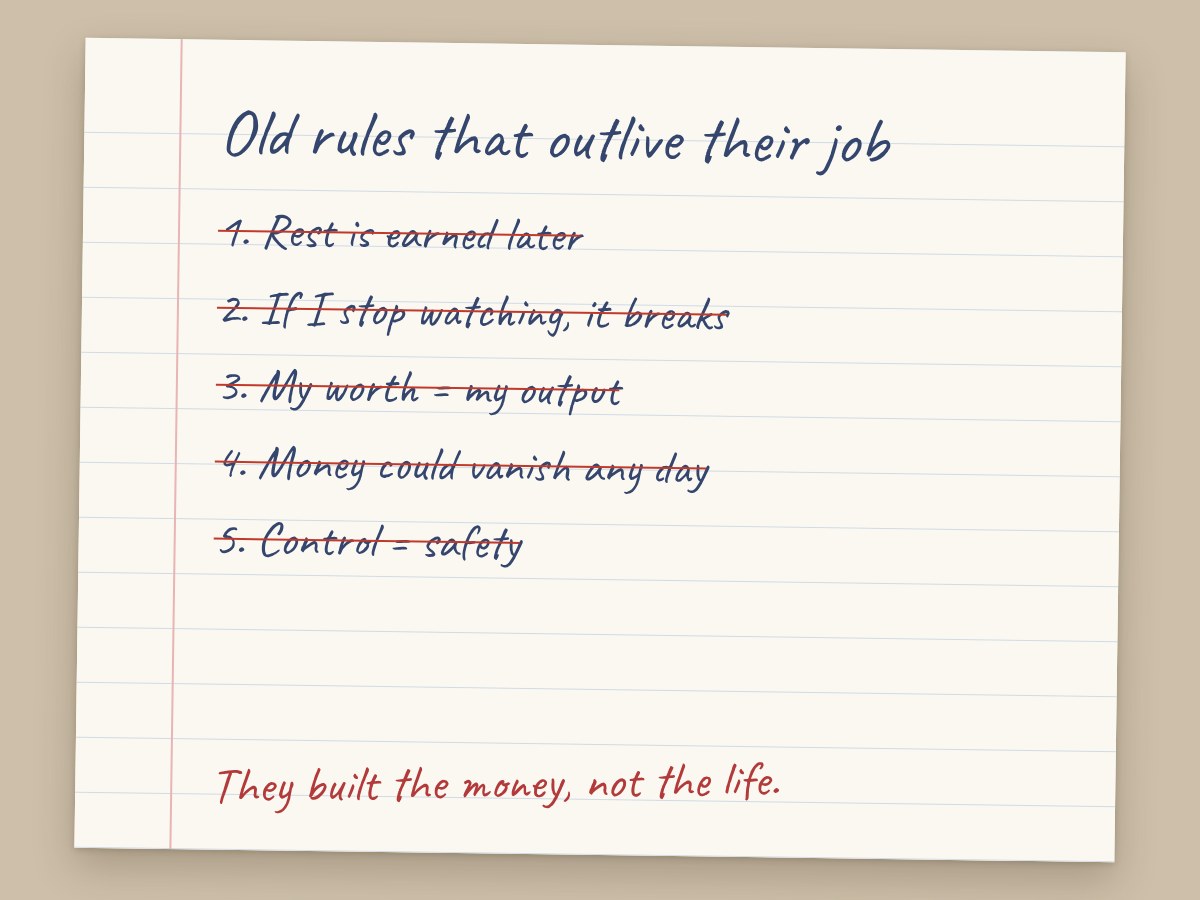
Here are five common ones, written as the plain rules they tend to be:
1. “Rest is something I earn later”
This belief gets a company through its first hard years. Later never arrives, because the belief has no finish line written into it. The founder who once worked through weekends to make payroll is still working through them with ten years of runway in the bank.
2. “If I stop watching, it goes wrong”
Vigilance protected the company when it was small and fragile. At scale, it turns into checking work that other people are paid to own, and it makes genuine time off feel unsafe. The body is on a beach. The attention is in the Monday meeting.
3. “My worth is what I produced this quarter”
When identity is fused with output, a quiet week feels like a personal failure. This is the same pattern I wrote about in Identity After Selling a Company: when the title or the results go, the sense of self tends to wobble with them.
4. “Money could disappear at any moment”
A healthy respect for risk is useful. A scarcity reflex that never updates is something else. It shows up as an inability to spend on anything that isn’t an investment, guilt about comfort, or treating every family purchase as a negotiation.
5. “If I control enough, I’ll finally feel safe”
This is the deepest one. Control builds companies. It does not build calm, because there is always one more thing that can’t be controlled. The person who believes safety comes from control will keep reaching for more of it at every level of wealth.
What enjoying what you’ve built actually looks like
It is worth being specific, because “enjoy it” is the kind of advice that sounds obvious and changes nothing. In practice, a founder who has made peace with what they’ve earned usually shows a few concrete signs:
- They can take a week off without checking in, and the business is fine because it was designed to be.
- They spend on what they value without a story about whether they deserve it.
- They choose their next project because it interests them, not because stopping feels dangerous.
- Their family gets their full attention at dinner, not the leftover attention after the phone.
- They can say “this is enough for now” about a target and mean it, without losing ambition.
That last point matters. Enjoying what you have built is not the same as giving up drive. When you no longer need the next result to prove anything, ambition becomes something you choose rather than something that drives you. That is a very different place to make decisions from, and it usually produces better ones, a point I made from a different angle in my field guide to decision-making under pressure.
From control to surrender: a practical definition
I use the word surrender in my work, and it can sound passive to people who run companies. I mean something specific and practical by it: letting go of the need to control outcomes you were never fully in charge of, so that your energy goes into what you actually influence.
Surrender is not carelessness. You still set direction, hire well, read the numbers and make the hard calls. What changes is the inner contract. Instead of “I will be calm once everything is secured”, the working belief becomes “I can do my part well and be at peace with what I don’t control.” The first belief keeps you running forever. The second lets you stop at the end of the day.
For a founder who has crossed $10 million, this is often the real shift. The strategy problems of the next stage are well covered, and I wrote about why they stall in Why Strategy Stops Scaling Past $10 Million. The personal problem is quieter: learning to live in the life the strategy paid for.
Where I come at this from
My own work started far from boardrooms. I closed AED 96 million of property sales in Dubai in fourteen months and wrote about that period in my book, Zero to 96 Million in 14 Months. Through Realtor One, I have since coached more than 5,000 Dubai realtors. The principle I teach there is that what a person believes is possible decides what they will attempt.
The work with founders and CEOs adds the other half of that principle: what a person believes they are allowed to have decides what they can actually enjoy. That private work stays private, so I won’t describe anyone’s situation here. The method is the same at every level. Name the belief, see where it came from, and test whether it still deserves to run your life.
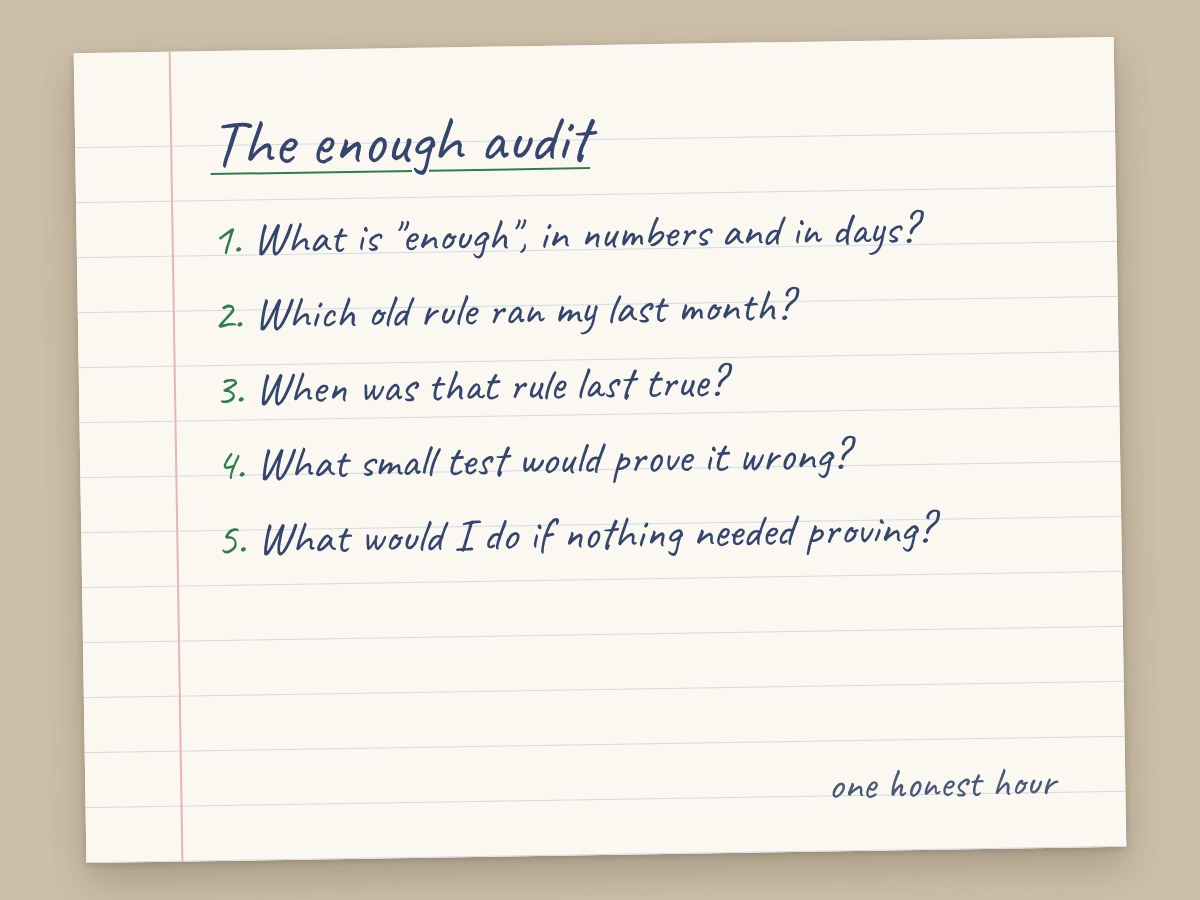
The enough audit: five questions for this week
You don’t need a retreat to start. Set aside an honest hour, ideally away from the office, and write down your answers to these five questions. Be concrete, and use real examples from the last month.
1. What does “enough” mean, in numbers and in days?
Write the financial figure at which you would stop feeling pressure. Then write what an ordinary good week would look like if you were already there. If you can’t describe the week, the number was never the real target.
2. Which old rule ran my last month?
Look at the list of five beliefs above. Which one made the most decisions for you recently? Find one specific moment, such as a cancelled day off or a refused purchase, where you can see it at work.
3. When was that rule last true?
Most of these rules were formed at a particular time: a near miss with cash, an early betrayal, a year when everything depended on you. Write down when the rule was last accurate, and whether those conditions still exist.
4. What small test would prove it wrong?
Design one safe experiment for the next two weeks. Take a full day without checking in. Let your number two run a meeting you normally lead. Spend on something you value without justifying it to anyone. Decide in advance what result would make you doubt the old rule.
5. What would I do next if nothing needed proving?
This is the question that moves you from relief to direction. Your answer might be a new venture, more time with family, or giving something back. Whatever it is, notice whether it feels chosen or compulsory. For many people the answer leads straight to the question of what they actually want to leave behind.
Signs the old mindset is still in charge
If two or more of these are true, the habits that built your wealth are probably still running your days:
- You feel guilty on days when nothing urgent happens.
- You moved the finish line the last time you reached it, without deciding to.
- Rest only feels allowed when you are ill or exhausted.
- You describe your wealth mainly in terms of what could go wrong with it.
- The people closest to you say you are present in body but not in attention.
- You would tell a friend in your position to slow down, and you don’t.
None of these is a diagnosis. They are prompts. If you notice persistent low mood, anxiety or exhaustion, the right first step is a doctor or a licensed professional, not an adviser. For the leadership side of it, the four-step audit in Belief Work for Executives works on any assumption you find, and a neutral thinking partner helps with the ones you can’t see on your own.
Frequently asked questions
Why don’t I feel satisfied after making a lot of money?
Usually because the beliefs that drove you to earn it are still active. Rules like “rest is earned later” or “control equals safety” have no built-in finish line, so they keep running regardless of the balance. Changing how it feels means updating those rules, not adding to the number.
Does enjoying what I’ve built mean losing my ambition?
No. The aim is to make ambition a choice rather than a compulsion. Many founders find they think more clearly about what comes next once they stop needing the next result to feel safe.
How long does this kind of change take?
There is no fixed timeline, and I would be cautious of anyone who promises one. Noticing a belief can happen in an hour. Living differently usually takes weeks of small, repeated tests in real life.
If you have built more than you ever planned and still can’t switch off, it may help to talk it through with someone outside your company and your family. I offer a free, one-hour, fully confidential conversation for founders and CEOs. Book a private conversation with Aanant.