By Aanant Bisht · 28 November 2026
“Belief work” is a phrase that makes many senior people uneasy, and I understand why. It sounds soft. It sounds like affirmations on a bathroom mirror, or a weekend retreat that feels wonderful on Sunday and changes nothing by Wednesday.
That is not what I mean by it. Belief work for executives, done properly, is one of the most practical things a leader can do. It means finding the working assumptions that sit underneath your decisions, checking them against evidence, and changing the ones that no longer fit the business you are running. This essay sets out what it is, what it isn’t, and a simple way to start on your own.
What belief work for executives actually is
Every leader runs on assumptions. Most of them are useful. “If I don’t check this myself, it will go wrong” may have been true when the company had eight people. “The board only respects numbers” may have been true of a previous board. “If I slow down, we lose” may have been true in the first two years.
The trouble is that these assumptions rarely announce themselves. They don’t feel like beliefs. They feel like facts about the world, or about you. And because they feel like facts, they are never tested. They simply shape what you attempt, what you avoid, who you trust and how long you wait before making a hard call.
Belief work is the discipline of making those assumptions visible and then treating them as what they are: hypotheses. Some will hold up. Some will turn out to be true only some of the time. A few will turn out to be costing you far more than they protect.
The best-known practical version of this comes from Robert Kegan and Lisa Lahey at Harvard, whose book Immunity to Change is built on the idea of what they call “big assumptions”. In a Q&A published by the Harvard Graduate School of Education, Kegan explains that these assumptions are “big” because we are currently taking them as certain truths, not just assumptions, which may or may not be true. Their approach asks people to take an inquiring stance and run small experiments to see whether an assumption deserves to be kept as it is. I find that framing useful precisely because it is so unmystical. You are not fixing yourself. You are checking your data.
What belief work isn’t
It helps to be clear about the edges, because most of the scepticism about this work comes from things that borrow the name.
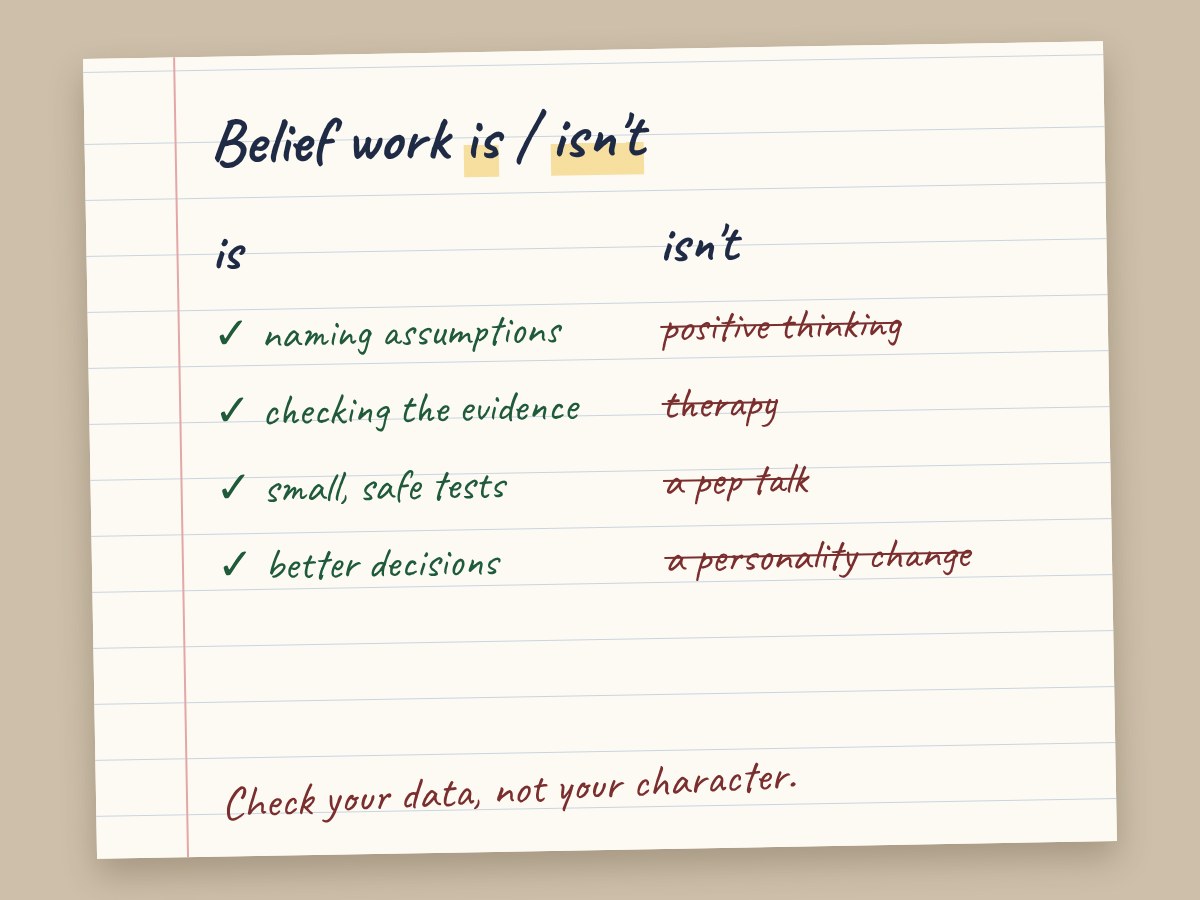
It isn’t positive thinking
Repeating “I am a confident leader” does nothing to the assumption that makes you hesitate before confronting a co-founder. Positive thinking tries to paint over a belief. Belief work asks where it came from and whether it is still accurate. Sometimes the honest answer is that the cautious belief is right, and you should keep it.
It isn’t therapy
Therapy is clinical care delivered by qualified professionals, and it matters. Belief work as I practise it is advisory. It is focused on how you lead and decide, not on diagnosing or treating anything. If someone is dealing with persistent low mood, anxiety or trauma, the right person to see is a doctor or a licensed therapist, not an adviser.
It isn’t motivation
Most executives are not short of drive. If anything they have too much of it pointed in too many directions. A motivational talk adds energy to whatever assumptions are already running. Belief work changes the direction, which is usually the more valuable thing.
It isn’t a personality makeover
You do not need to become a different person. A careful, analytical CEO does not need to become a showman. The aim is narrower and more useful: to stop a handful of outdated assumptions from making decisions on your behalf.
It isn’t a one-off event
An insight in a workshop is a start, not a result. Assumptions change when you act differently and see what actually happens, again and again, in the real business. That takes weeks, not an afternoon.
Why it matters more the more senior you are
When you are early in a career, an untested assumption mostly affects you. When you run a company, it affects everyone below you. Your beliefs about risk become the company’s risk appetite. Your beliefs about trust become its delegation structure. Your belief about what happens if you say “I don’t know” becomes the culture of the leadership meeting.
Seniority also removes the people who would normally challenge you. Fewer people disagree with a CEO than with a manager, and the ones who do often soften it. That is part of why I wrote about the value of a thinking partner for founders: an assumption you never say out loud to anyone is an assumption nobody will ever question.
Pressure makes it worse. Under time pressure, people fall back on what feels certain, and what feels certain is exactly the set of beliefs that have never been tested. In my field guide to decision-making under pressure I suggested slowing the decision down enough to see it clearly. Belief work is what you do in calmer weeks so that there is less hidden inside the decision when the pressure arrives.
Where I come at this from
I don’t write about belief as theory. In Dubai I closed AED 96 million of property sales in fourteen months, and I wrote that period down in my book, Zero to 96 Million in 14 Months. The lesson I took from it, and the one I have built into how I coach more than 5,000 Dubai realtors through Realtor One, is that what a person assumes is possible decides what they are willing to attempt. Technique matters, but it only gets used inside the limits of what someone believes is worth trying.
The same principle holds at the top of a company, with larger stakes. The private work I do with founders and CEOs stays private, so I won’t describe it here. What I can say is that the method does not change with seniority. It is the same patient process of naming, tracing and testing, applied to bigger decisions.
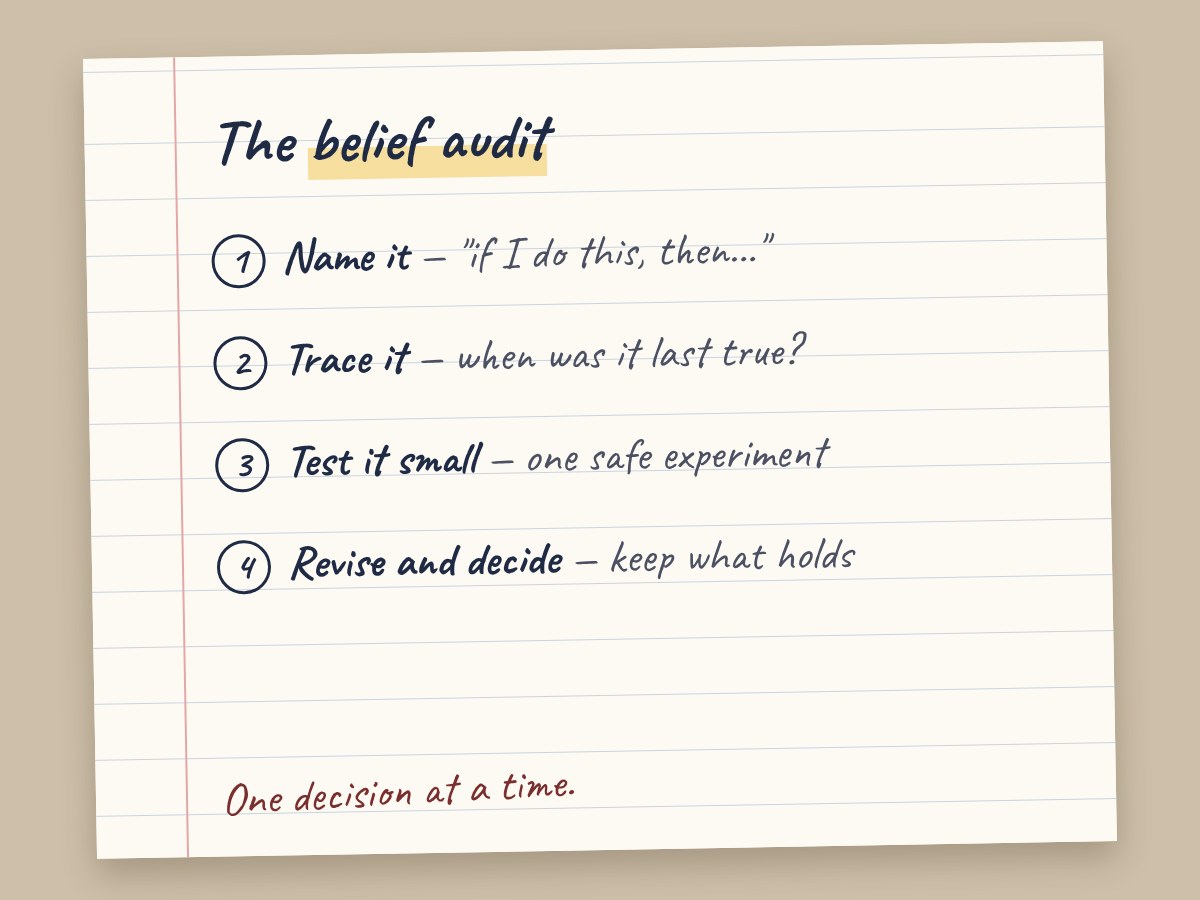
The belief audit: a four-step method you can use this week
You can start belief work for executives on your own, with a notebook and an honest hour. Use these four steps on one live decision or one recurring frustration, not on your whole life.
1. Name the assumption
Pick something you keep meaning to do and keep not doing: delegating a key client, replacing a senior hire, raising a hard topic with your board. Then finish this sentence in writing: “If I do this, I’m afraid that…” Whatever follows is close to the assumption. Rewrite it as a plain if-then statement, such as “If I hand over this client, the relationship will weaken and it will be my fault.”
2. Trace where it came from
Ask when this belief was last true. Many leadership assumptions were formed in a specific moment: a hire who let you down, an early near-miss with cash, a boss who punished bad news. Write down the original evidence. Then ask honestly whether the conditions that made it true still exist.
3. Test it small
Design one safe, modest experiment you can run within the next week or two that could prove the assumption wrong. Hand over one smaller client relationship. Share one piece of bad news early and plainly. Leave one decision entirely to your number two. Decide in advance what result would make you doubt the assumption, so you are collecting evidence rather than looking for comfort.
4. Revise and decide
Look at what actually happened, including how you felt. Keep the parts of the belief the evidence supports. Rewrite the rest into something more accurate, for example: “Handing over a client works when I stay visible for the first month.” Then make the decision you were avoiding, using the revised version.
Signs a belief, not the facts, is making the call
Use this checklist when a decision feels stuck. Two or more ticks usually mean there is an assumption worth auditing.
- You have had the same conversation about the same decision for more than a quarter.
- You can explain the logic for acting, and still don’t act.
- Your reaction to the topic is stronger than the facts seem to justify.
- You use words like “always”, “never” or “everyone” when you describe it.
- The reason you give for waiting has changed several times, but the waiting hasn’t.
- You would give a peer the opposite advice in the same situation.
- You feel relief, not clarity, when the decision is postponed again.
None of these proves anything on its own. Together they suggest that the decision is being made somewhere other than the spreadsheet. The emotional side of this, feeling the pull of a reaction without letting it run the room, is what I covered in Emotional Mastery for CEOs.
The beliefs that change at transitions
Belief work becomes most urgent at the edges of a role, when the assumptions that served one chapter start working against the next. A founder who becomes CEO of a larger company has to give up the belief that the best work is the work they do personally. A leader preparing for succession has to examine the belief that the company needs them in order to survive. After an exit, many people discover how much of their sense of self rested on a single title, which is the question I explored in Identity After Selling a Company.
And at the longest range, what you believe about what matters shapes what you leave behind, in your family as much as your company. That is the subject of Legacy Beyond the Will.
Frequently asked questions
Is belief work the same as executive coaching?
It overlaps, but the focus is narrower. Much executive coaching is about skills, goals and behaviour. Belief work looks at the assumptions that drive the behaviour, so that the change holds when pressure returns.
How long does belief work take?
There is no fixed timeline, and I would be wary of anyone who promises one. Naming an assumption can take an hour. Testing it properly usually takes several weeks of small experiments in the real business.
Can I do belief work on my own?
Yes, and the four-step audit above is designed for that. The hardest part alone is step one, because the assumptions that cost the most are usually the ones you can’t see. That is where a neutral second person helps.
If a decision keeps stalling and you suspect the reason isn’t on the spreadsheet, it may help to look at it with someone neutral. I offer a free, one-hour, fully confidential conversation for founders and CEOs. Book a private conversation with Aanant.