By Aanant Bisht · 26 November 2026
When a CEO says the word “legacy”, the conversation usually turns to documents. The will, the trust, the shareholding, the foundation, perhaps a name on a building. Those things matter, and they deserve good lawyers and good advisers. But they are the smallest part of what a CEO actually leaves behind.
The bigger part is written every week, in ordinary decisions: who you develop and who you keep dependent on you, what your company learns to do without you, how present you are at home, and whether the person you became while building all of this is someone you are at peace with. That is the part of legacy I work on as a legacy advisor for CEOs, and it is the part most leaders leave until it is too late to shape.
Why the will is the smallest part of a CEO’s legacy
A will decides who receives what you own. It cannot decide what those people do with it, how they remember you, or whether the company you built keeps its judgment once you have gone. Those outcomes are set long before any document is read, by thousands of small choices made while you were busy running the business.
That is why I find it more useful to treat legacy as something you are already writing rather than something you will one day plan. Every time you make a decision yourself that your team could have learned to make, you write one kind of legacy. Every time you take the slower route and teach the reasoning behind it, you write another. Neither shows up in a balance sheet, and both outlast you.
What people say about legacy at the very end
One of the most honest sources on this is not a business book. Bronnie Ware, who spent years working in palliative care, wrote about the regrets her patients shared in the last weeks of their lives. In her account of the five most common regrets, the second was “I wish I hadn’t worked so hard”, which she says came from every male patient she nursed. They missed their children’s youth and their partner’s companionship.
She also writes that people wanted their financial affairs in order, but mostly for the benefit of those they loved, and that in the end it came down to love and relationships. I do not read that as an argument against ambition. I read it as a warning about which ledger gets neglected when a capable person is busy. The financial side of legacy tends to get attention because it has deadlines, professionals and paperwork. The human side has none of those, so it waits, quietly, until it cannot.
Where I learned that legacy lives in habits, not headlines
I closed AED 96 million in Dubai property sales in fourteen months, and later wrote that period down in my book, Zero to 96 Million in 14 Months. Turning those months into a book meant answering a different question from “what did I achieve?”. It meant asking “what did I actually do, every day, that someone else could repeat without me in the room?” A number is a result. A method is something you can hand over.
The same question shaped how I built Realtor One, where I have coached more than 5,000 Dubai realtors. I cannot be on every call those realtors make. What lasts is not my presence; it is the habits and the way of thinking they keep using when I am nowhere near them. That is the clearest picture of legacy I know: what keeps working after you have stepped away.
For a CEO, the scale is different but the test is the same. If you disappeared for six months, which decisions would still be made well, and which would quietly wait for you?
The four ledgers of a CEO’s legacy
When I help a leader think about legacy, I use four ledgers. Each one is being written right now, whether or not anyone is keeping track.
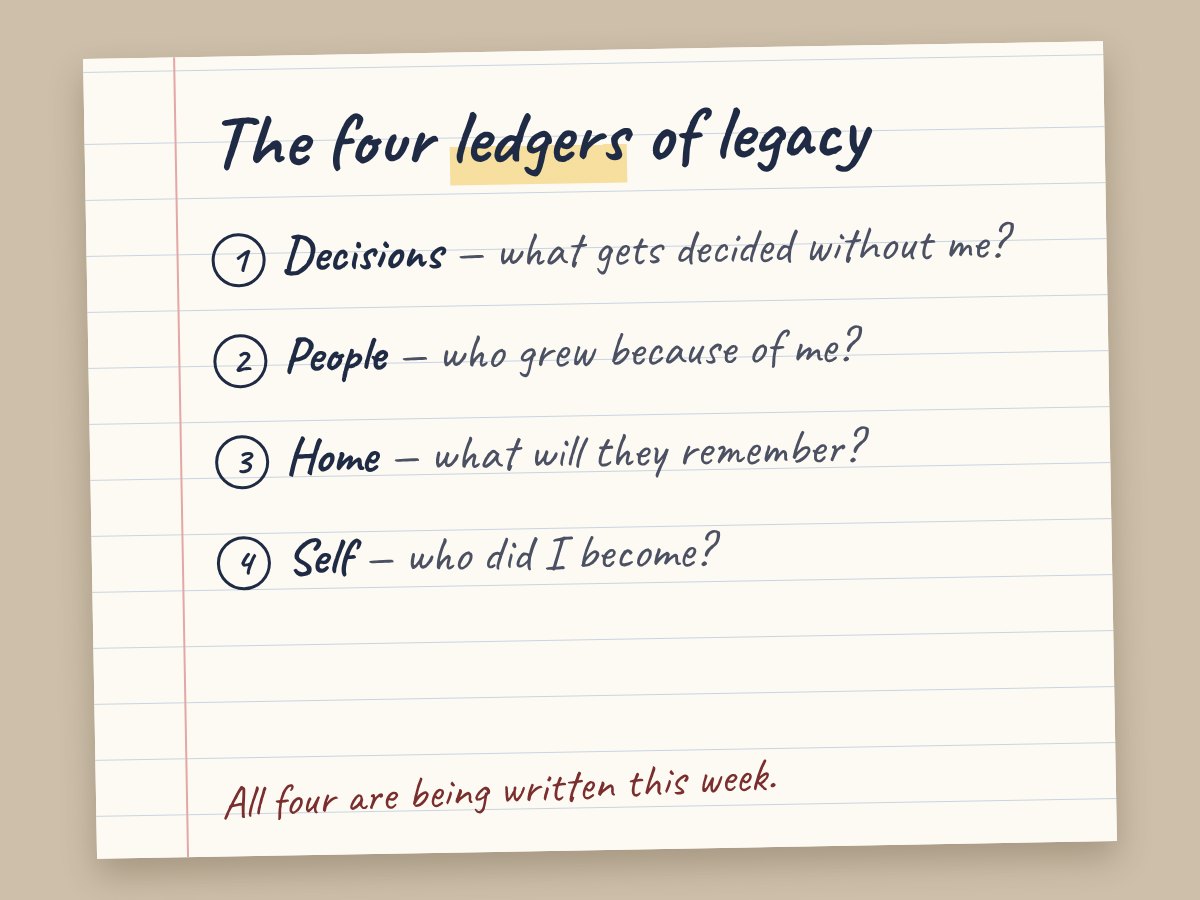
1. The decisions ledger: what your company knows how to decide without you
Many founders build companies that are excellent at executing and poor at deciding, because every hard call still routes to one desk. Ask which of your last ten significant decisions could have been made by someone else if they had understood your reasoning. Then ask whether you have ever explained that reasoning out loud. I wrote about how decisions change shape as a company grows in Why Strategy Stops Scaling Past $10 Million.
2. The people ledger: who became more capable because they worked with you
This is not the same as who stayed loyal. Some of the best evidence of a leader’s legacy is the people who left to run something of their own, using what they learned. Look at your senior team and ask, honestly, who is ready for your job, who could be in three years, and whether you are helping or quietly in the way.
3. The home ledger: what the people closest to you will actually remember
Your family will not remember the quarter you hit a record. They will remember whether you were present when you were home, whether you kept the promises that were inconvenient, and how you behaved under pressure. That last one matters more than most leaders think; how you carry stress is something your family learns from watching. I covered the inner side of that in Emotional Mastery for CEOs.
4. The self ledger: who you became while building it
This is the quietest ledger and often the heaviest. Did you become more honest or more guarded, more generous or more controlling? Did the beliefs that drove you early, the need to prove something or never to be poor again, get updated once they had done their job? A leader can build an extraordinary company and still be uneasy with the person who built it. That unease tends to leak into the other three ledgers.
A one-hour legacy audit you can do this month
You do not need a retreat for this. Block one uninterrupted hour, take a sheet of paper, and answer these in writing. Short, honest answers beat polished ones.
- The absence test. If I stepped away for six months from tomorrow, which three decisions would stall? Who should be able to make them, and what would they need to understand first?
- The successor list. Name the two or three people I am actively developing. If I cannot name anyone, that is the answer.
- The calendar check. Look at the last four weeks. How much of my time went to things only I can do, and how much to things I simply prefer to control?
- The home question. If my partner or children described the last year of me in one sentence, what would it be? Would I want it read out?
- The belief review. What is one belief that built my success that I am still obeying, even though it no longer serves the stage I am at?
- The paperwork gap. Are my will, ownership structure and succession documents current, and do the people affected know enough to act if they had to? If not, which professional do I need to call?
- The one change. Of everything above, what is the single change I will make in the next 30 days, and who will I tell so it actually happens?
The last question matters most. An audit that ends in reflection changes nothing. An audit that ends in one committed decision, shared with one other person, starts to rewrite the ledger.
What a legacy advisor for CEOs does, and what it doesn’t
The phrase can mean different things, so it is worth being precise.
- Not an estate lawyer or wealth manager. Wills, trusts, tax and ownership structures belong with qualified legal and financial professionals. A good legacy conversation often ends with “you need to call your lawyer this week”, not with a replacement for one.
- Not a biographer or PR adviser. Reputation management shapes how you are described. Legacy work is about what you actually do, which is what the description eventually has to match.
- Not therapy. If something heavier is going on, such as grief, burnout or a mental health concern, a licensed professional is the right person, and a good adviser will say so.
- What it is: a confidential, neutral space to look at the four ledgers honestly, test decisions about succession, time and family against what you actually value, and follow up on whether the decisions were carried out. It is close to what I described in A Thinking Partner for Founders, applied to the longest-term questions a leader faces.
When to start thinking about legacy
Most CEOs assume legacy is a topic for the last chapter, after an exit, before retirement or after a health scare. By then the decisions and people ledgers are largely written, and the home ledger has had years of entries. The leaders who end up at peace with what they leave behind tend to start much earlier, while they still have the most power to change the outcome.
A few signals that now is the time:
- The company is growing, but more decisions are coming to you, not fewer.
- You are thinking about a sale, a fundraise or stepping back, and the question “then what?” makes you uneasy.
- Someone close to you has said, more than once, that you are never really present.
- You have achieved the target you set years ago and feel less settled than you expected.
None of these are emergencies. They are invitations to look at the ledgers while there is still plenty of time to write in them. If a big decision is part of the picture, my field guide to decision-making under pressure is a useful companion to this audit.
Frequently asked questions
What is a legacy advisor for CEOs?
A legacy advisor for CEOs helps a leader think through the non-financial side of what they leave behind: how the company decides without them, who they develop, their relationships at home, and who they become. It works alongside, not instead of, legal and financial advisers who handle estates and succession documents.
Is legacy planning only for older or retiring CEOs?
No. The earlier you start, the more of the outcome you can still shape. Founders in their thirties and forties are writing their legacy every week through how they build their teams and spend their time.
How is this different from succession planning?
Succession planning usually focuses on who takes over a role and when. Legacy work includes that, but also asks whether the company can make good decisions without you, and what you leave behind outside the business.
Related essay: Identity After Selling a Company: Who You Are After the Exit
If you have built something significant and the question “what will this leave behind?” keeps coming back, it may help to think it through with someone neutral. I offer a free, one-hour, fully confidential conversation for founders and CEOs. Book a private conversation with Aanant.